
Business process automation that pays for itself
Kynera engineers workflow and business process automation across existing business systems - converting manual operational load into capacity that supports growth without proportional cost.
+ WORKFLOW AUTOMATION
+ SCALE & MARGIN
+ PROCESS RE-ENGINEERING


An order that processes itself
Before
Email arrives → someone types it into the system → checks stock by hand → emails the warehouse → updates the tracking sheet → accounting types it again to raise the invoice → nothing moves while that person is away

Order arrives → the system reads it → checks price, stock and credit terms → creates the order → notifies the warehouse → raises the invoice from the same record → anything that fails a rule is routed to a person with the reason attached
Business Process Automation Services
End-to-End Process Automation

Automation of work as it moves between systems, departments, and stages. Processes execute continuously on defined rules, with exceptions routed automatically.
Order-to-Cash Automation
Automated flow from incoming order through fulfilment to issued invoice. Shorter cash cycle and fewer errors introduced by manual re-entry at each handoff.
n8n / Make / Zapier Implementation
Building and migrating automations onto platforms under direct client ownership, including self-hosted deployment. Full visibility into what runs, at what cost, with no dependency on a single vendor.
Procurement & Inventory Automation
Automated purchase order generation, replenishment triggers, and supplier communication driven by live inventory and demand signals.
AP / AR & Invoice Automation
Automated processing of incoming and outgoing invoices, reconciliation, and receivables tracking. Finance shifts from data entry to exception handling.
Custom Automation Development
Engineering for processes that no platform or connector covers - custom logic, internal applications, and purpose-built tools where configuration alone cannot reach.
Business Process Automation Services
End-to-End Workflow Automation
Automation of work as it moves between systems, departments, and stages. Processes execute continuously on defined rules, with exceptions routed automatically.
discussOrder-to-Cash Automation
Automated flow from incoming order through fulfilment to issued invoice. Shorter cash cycle and fewer errors introduced by manual re-entry at each handoff.
discussn8n / Make / Zapier Implementation
Building and migrating automations onto platforms under direct client ownership, including self-hosted deployment. Full visibility into what runs, at what cost, with no dependency on a single vendor.
discussProcurement & Inventory Automation
Automated purchase order generation, replenishment triggers, and supplier communication driven by live inventory and demand signals.
discussAP / AR & Invoice Automation
Automated processing of incoming and outgoing invoices, reconciliation, and receivables tracking. Finance shifts from data entry to exception handling.
discussCustom Automation Development
Engineering for processes that no platform or connector covers - custom logic, internal applications, and purpose-built tools where configuration alone cannot reach.
discussFrom process reality to working automation
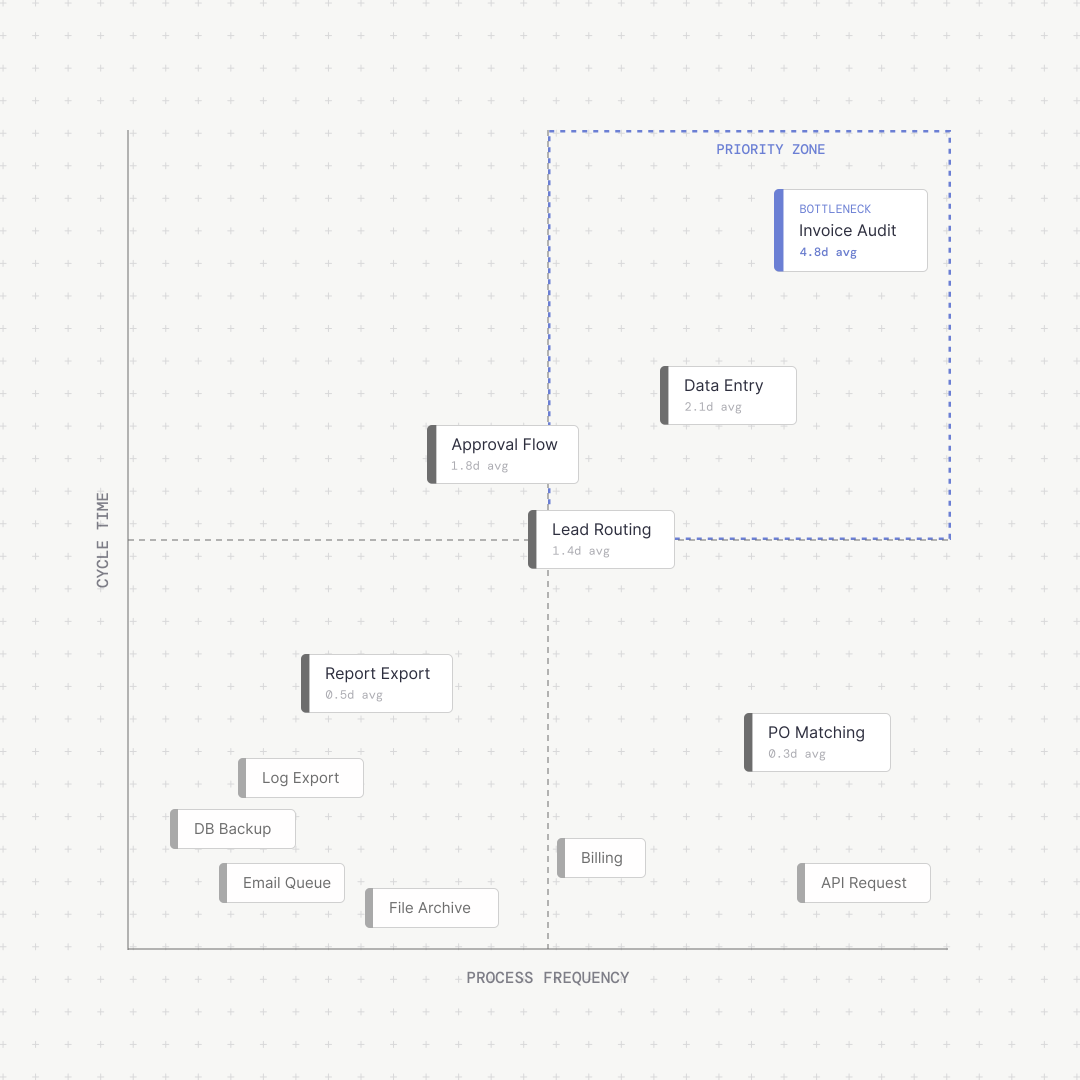
Process Intelligence
Prioritization starts from measurement, not from what feels slowest.
The processes that consume the most time are rarely the ones people complain about. Establishing where cycle time actually accumulates requires system evidence: transaction timestamps that reveal how long work waits between stages, automation and integration logs that show what already runs and at what cost, and audit trails that expose how often the same record is corrected. Where system records do not reach — and in most mid-market environments they do not reach everywhere — direct observation fills the gap.
The output is a measured picture of where manual effort concentrates, which is the only reliable basis for deciding what to automate first.

Priority Architecture
Return and complexity are assessed together.
Automation programs stall when sequencing is driven by enthusiasm rather than economics. Every candidate process is positioned on two axes: the margin it influences and the effort required to change it.
High-return, low-complexity work is delivered first — not because it is easy, but because it produces results early enough to fund and justify the more involved projects behind it. Processes that are complex and low-return are documented and deliberately left alone.
The sequence matters as much as the selection: an automation program that shows measurable return in its first stage rarely gets cancelled in its third.

Reengineering Before Automation
Automating a broken process produces a faster broken process.
Where the underlying flow is the problem, automation amplifies it — errors propagate faster, exceptions multiply, and the resulting system is harder to correct than the manual process it replaced.
The flow is redesigned first: duplicate checks removed, approval logic simplified, handoffs consolidated, and exception paths defined explicitly rather than handled by whoever notices. Only then is the process automated, and only then does it scale.
This is also where automation intersects with data — a process cannot be reliably automated on inputs that disagree, which is why data quality work often precedes automation work rather than following it.
How an Automation Project Works
From initial assessment to operational infrastructure
Process Assessment + Prioritization
Measuring where manual work concentrates and what it costs, using system data where available. Processes are ranked by return and feasibility.
Process Design & Rules Definition
Defining the target flow: triggers, routing rules, approval logic, and exception handling.
Build & Integration
Building the automation and connecting the systems it depends on. Existing tools remain in place.
Testing & Controlled Rollout
Running automated and manual paths in parallel until output is verified, then transitioning fully.
Monitoring & Handover
Establishing failure alerts, documentation, and operational ownership.
Our Clients’ Success in Process Automation


.png)
Higher Throughput Without Added Headcount
Fewer Errors and Less Rework
Faster Cycle Times
Consistent Process Execution
Reduced Dependency on Individuals
Visibility Into Where Work Stalls
Through process mining and operational audit - we map actual workflows, quantify time and cost per process, and prioritize by impact and feasibility.
Rarely. We automate within and between your existing systems - replacing only what creates friction that can't be resolved otherwise.
Depends on scale and complexity. Make, n8n, and Zapier for standard workflows. UiPath for enterprise RPA. Custom development when standard tooling becomes cost-inefficient.
Typical reduction in manual operational overhead: 40-60%. Exact figures depend on current state and scope.
Not necessarily. We build for maintainability and document everything. Where needed, we provide ongoing support.
First quick wins typically within 4-6 weeks. Full automation program: 3-6 months.
Finance, HR, operations, procurement, logistics, and customer service - wherever manual processes create measurable cost or delay.
No. Automation handles defined, repeatable processes. AI is applied where pattern recognition, prediction, or content understanding is required. We are clear about which is appropriate for each task.
Let's establish whether Kynera is the right fit for your organization
