
One data layer for every system in the business
Kynera connects and cleans the data scattered across disconnected systems, unifying it into one reliable layer - the integration and data management foundation that automation, reporting, and applied AI depend on.
+ REAL-TIME VISIBILITY
+ SINGLE SOURCE OF TRUTH


Most mid-market businesses run on systems that were added one at a time as the company grew. Orders live in one place, inventory in another, financials in a third, and none of them agree. Every report becomes a reconciliation exercise, every decision waits on someone assembling a spreadsheet, and every automation built on top inherits the inconsistencies underneath it.

A unified data layer connects these sources into one governed structure. Records are matched and deduplicated, formats are standardized, and synchronization runs continuously rather than overnight. The result is a single set of numbers that reporting, automation, and AI systems can all rely on — and a foundation that absorbs new systems instead of breaking when they are added.
Data Integration & Data Management Services
Data Integration

Connecting business systems into a single data layer that reporting and operations can rely on. One consistent set of numbers in place of multiple exports that never fully reconcile.
Data Quality Remediation
Cleanup and standardization of accumulated data: duplicates, gaps, and inconsistent formats. Automation and AI produce reliable results only when the underlying data is sound.
Real-Time Data Synchronization
Continuous alignment of data across systems rather than overnight batch updates. A change recorded in one system stops becoming a discrepancy in three others.
Master Data Management
One agreed record for every customer, product, and vendor, with defined ownership and change rules. Removes the ambiguity of competing versions across departments.
Data Migration
Moving data through system replacements and consolidations without loss or operational downtime. Historical records remain usable for analysis rather than becoming a dead archive.
Data Access & Permissions Design
Structured rules governing which roles access which data, and at what level of detail. Teams receive what they require without exposing margin, cost, or client information beyond its intended scope.
Data Integration & Data Management Services
Data Integration
Connecting business systems into a single data layer that reporting and operations can rely on. One consistent set of numbers in place of multiple exports that never fully reconcile.
discussData Quality Remediation
Cleanup and standardization of accumulated data: duplicates, gaps, and inconsistent formats. Automation and AI produce reliable results only when the underlying data is sound.
discussReal-Time Data Synchronization
Continuous alignment of data across systems rather than overnight batch updates. A change recorded in one system stops becoming a discrepancy in three others.
discussMaster Data Management
One agreed record for every customer, product, and vendor, with defined ownership and change rules. Removes the ambiguity of competing versions across departments.
discussData Migration
Moving data through system replacements and consolidations without loss or operational downtime. Historical records remain usable for analysis rather than becoming a dead archive.
discussData Access & Permissions Design
Structured rules governing which roles access which data, and at what level of detail. Teams receive what they require without exposing margin, cost, or client information beyond its intended scope.
discussHow a Data Integration Project Works
Discovery & Systems Assessment
Mapping existing data sources, systems, and integrations across departments — establishing what exists, what connects, and where the gaps are.
Data Architecture Design
Defining the unified layer: connection points, synchronization logic, storage decisions, and ownership rules.
Pipeline Development & Ingestion
Building secure pipelines that automate data flow from every source into a continuous, monitored stream — without interrupting operations.
Data Governance & Quality Controls
Implementing ownership structures, access permissions, and quality rules so the layer stays reliable as the business grows.
Validation & Operational Handover
Testing data integrity across connected sources, documenting the architecture, and transferring operational ownership.
Business outcomes of data unification
Most operational problems attributed to process or staffing originate in data. When order records, customer records, and financial records live in separate systems, every report becomes a reconciliation exercise and every automation inherits the inconsistencies beneath it.
Data integration work addresses this at the source. Once master data is governed, quality rules are enforced, and systems synchronize continuously, the effects extend well beyond reporting: automation becomes reliable because inputs are reliable, analytics and AI initiatives start from a prepared foundation rather than months of data preparation, and infrastructure costs fall as duplicate storage and point-to-point integrations are retired.
Lower Infrastructure and Licensing Costs
Elimination of redundant data silos and complex point-to-point integrations. Substantial reduction in cloud storage overhead and software licensing expenses across the entire ecosystem.
Accelerated Analytics and AI Readiness
Elimination of data preparation and manual cleansing bottlenecks. Immediate availability of harmonized, high-quality data pipelines directly reducing time-to-market for BI and AI applications from months to days.
A Foundation That Scales With Growth
New systems, channels, and entities connect into an existing structure instead of triggering another round of custom integration work. Growth stops multiplying operational complexity.
Reduced Dependency on Manual Reporting
Ad-hoc extracts and IT support requests are replaced by structured, self-service access. Operational teams retrieve validated figures directly instead of queuing for them.
What becomes possible once data is unified

Applied AI Systems
AI systems require clean, connected, and context-rich historical data.
Models trained on records that contradict each other return predictions nobody acts on. Agents querying fragmented context produce answers that are confident and wrong. Document processing writing into systems that disagree on what a customer record is creates work rather than removing it.
A unified layer gives every AI application one governed source to draw from — which is what separates a system that gets used from one that gets quietly abandoned after the pilot.

Decision Intelligence
Decisions are constrained by how long it takes to trust a number.
Most management reporting time is spent reconciling figures between systems rather than interpreting them. Competing versions and reporting latency are data problems, not analytical ones — and no dashboard resolves them.
When systems share one layer, reviews begin from agreed numbers. That is the precondition for forecasting, scenario modeling, and real-time visibility being worth building at all.
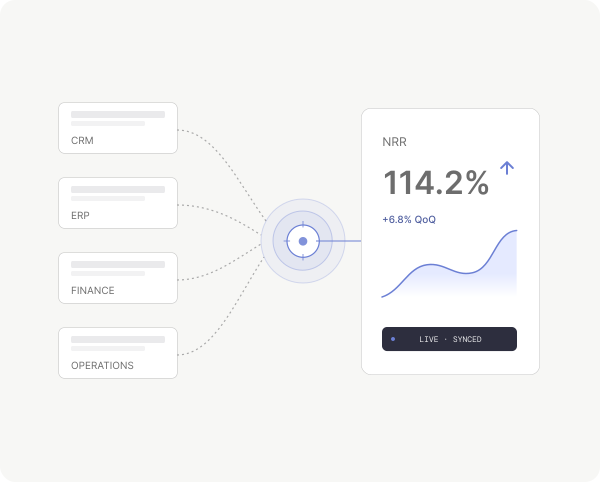
Analytics & Reporting
When data is unified at the core, reporting shifts from manual alignment to instant utility.
Most reporting effort goes into moving data rather than interpreting it - exports, manual alignment, and reconciliation before anyone looks at a result. Each recurring report becomes a recurring task.
A unified layer removes that step at the source, and the modeling layer above it holds metric definitions in one place rather than leaving them reconstructed in every spreadsheet. Recurring reports generate without intervention; teams retrieve validated figures directly.
.svg)
.svg)
No. Unified Data Layer connects to what you already have - CRM, ERP, WMS, databases, APIs, etc - without replacing them.
Typically 6-10 weeks depending on the number of sources and complexity of existing infrastructure.
No. We design for maintainability and document everything. Ongoing support is available where needed.
UDL scales to your current state - even two or three connected sources deliver immediate value in reporting clarity and process efficiency.
Cloud-based in most cases. Hybrid or on-premise available based on compliance or sovereignty requirements.
Engagement-based. Scoped after the initial discovery audit.
Let's establish whether Kynera is the right fit for your organization
