Most AI Spend Buys Activity, Not Margin
The difference between owning AI and profiting from it
Most companies that say they have an AI strategy have bought a tool and issued some licenses. The budget cleared, the training happened, adoption looks healthy on a slide. And when someone finally asks what it changed — what costs less, what moves faster, what stopped requiring three people and two days — the answer is a version of "people feel more productive." That answer costs money. Not because the tool failed, but because nobody decided, before buying it, what it was supposed to earn.
This is the gap between adopting AI and having a strategy for it, and it is not a small one. Adoption is a procurement decision. A strategy is a claim about where the business makes and loses money, and what a tool is supposed to do about it. The two get conflated constantly, and the cost of confusing them lands quietly on the margin, one unexamined subscription and one un-redesigned process at a time.
The reframe
Remove the word "AI" and the logic is obvious everywhere else in the business. No one calls a new inventory system a fulfillment strategy; the strategy is what gets prioritized, held, and reordered, and the system is what executes it. No one calls a project-management tool a delivery strategy; the strategy is how work is scoped, staffed, and billed to protect a margin, and the tool just tracks it. The tool is infrastructure. The strategy is the set of decisions about what the infrastructure is for. AI is the one category where companies routinely skip the decision, buy the infrastructure, and call the purchase itself the plan.
That skipped decision is exactly where the economic value lives. A tool used well by an individual saves that individual some time. A process rebuilt around a better decision moves the numbers a business is actually run on — the cost to complete a unit of work, the time to close a cycle, the share of output that has to be redone, the revenue that leaks through slow or inconsistent execution. A strategy is what connects the tool to one of those numbers on purpose. Without it, the tool still gets used. It simply never touches the economics, and the spend becomes permanent while the return stays theoretical.
What follows are the four places this breaks down in practice. They are not independent problems. They compound — each one makes the next more expensive — and together they explain why so much AI spend produces activity without result.
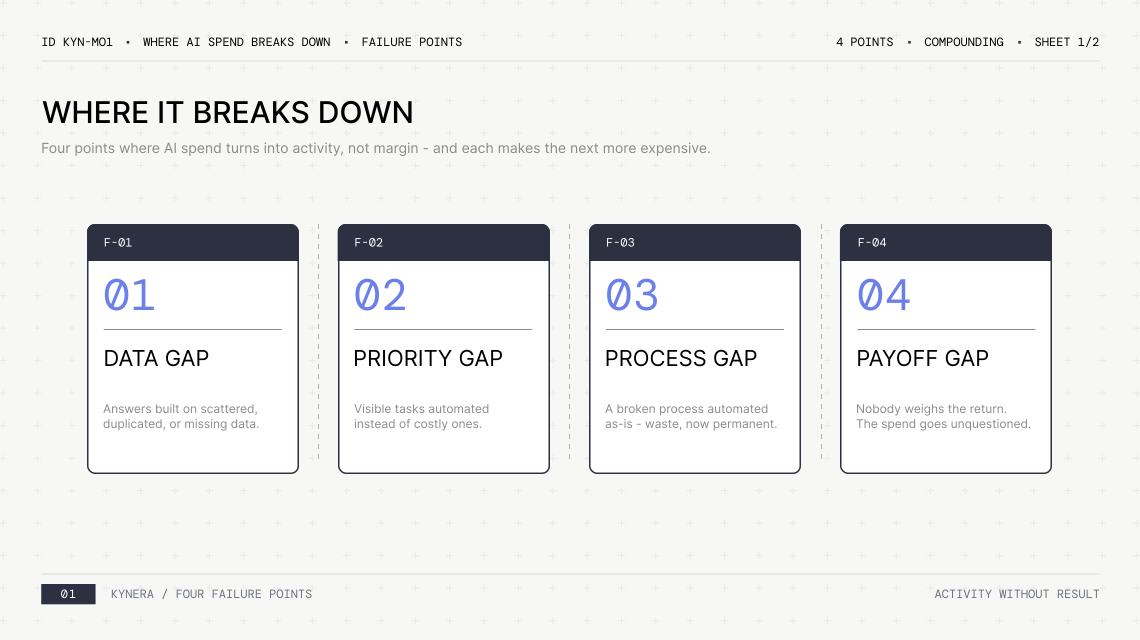
Where It Breaks Down
1. Data Gap
AI runs on data, and in most mid-market businesses the data is not in a state anything can run on. It is scattered across a dozen disconnected tools that were never meant to talk to each other. The same customer, order, or transaction exists in three systems under three slightly different names. Critical information still lives in spreadsheets, email threads, PDFs, and paper — never digitized, never structured, never reachable by a system that would need it. Whole categories of operational reality are simply not captured at all, because capturing them was never anyone's job.
Point an AI tool at that, and it does not warn you the picture is incomplete. It produces a confident, fluent answer built on whatever fraction of the truth it could reach — and a plausible answer drawn from partial data is more dangerous than an obvious error, because it gets trusted and acted on. The forecast is wrong in ways no one can see. The prioritization is skewed by the records that happened to be clean. The cost is not a visible failure; it is a stream of slightly-wrong decisions that no one traces back to the data underneath them. This is why data readiness comes first: until the information a tool depends on exists in a usable form, everything built on top of it inherits the same invisible unreliability — and getting the data into that form is usually the larger, less glamorous half of the work.
2. Priority Gap
Even with usable data, most companies aim AI at the wrong target — because they choose by visibility, not by cost. The task that gets automated first is the one people complain about out loud: drafting emails, summarizing meetings, generating first-pass reports. Meanwhile the process actually draining margin sits quietly in the background — a reconciliation that consumes a full role every month, a manual matching step nobody questions because it has always been done by hand, an approval chain that adds days to something that should take hours.
The visible task doesn't win because it's valuable. It wins because it's the one anyone can name in a planning meeting without first doing the work of measuring what anything costs. That measurement is the step almost everyone skips, and skipping it is expensive: budget and attention flow to the loudest inconvenience while the largest cost keeps running untouched. Automating a minor task well is not a strategy. Knowing which process, out of all of them, actually moves the P&L when it improves — that is where a strategy starts.
3. Process Gap
Automation makes a process faster. It does not make a bad process good — it makes it faster and permanent. Point a tool at a workflow that is inefficient by default — extra approvals that no longer serve a purpose, handoffs that exist only because two systems never connected, steps added years ago to patch a problem since solved — and all that happens is the waste now runs at speed and costs more to maintain. Worse, once the broken process is encoded into a tool, it becomes the system of record. The workaround is now permanent infrastructure, harder to see and more expensive to unwind than it was as a manual habit.
This is the difference between digitizing a business and optimizing one, and it is the difference most AI spend gets wrong. Real efficiency comes from redesigning the process to what it should be — then automating the version worth keeping. Skip the redesign, and a company pays good money to accelerate the exact inefficiency it was trying to eliminate, and adds a recurring license on top of it.
4. Economic Gap
A tool can be fully integrated — wired into the workflow, adopted by the team, working precisely as designed — and still lose money. Integration proves the tool is used. It says nothing about whether using it costs less than the problem it was meant to solve. The license renews, someone maintains it, someone reviews its output before trusting it — and none of that is ever weighed against what the process cost before the tool arrived, because the comparison was never set up.
Every other serious expense in a business gets this discipline automatically. A new machine gets a payback calculation. A new hire gets a target and a review. AI is the one investment companies routinely make without asking what it returns — so it accumulates as a fixed annual cost while the question of its actual worth goes unasked, unmeasured, and unanswered. This is the failure the other three lead to: a business can get the data right, pick the right process, and redesign it properly, and still waste the effort if no one ever confirms, in the numbers, that it paid off. Economic justification is not the last step of a good AI project. It is the point of one.

The AI Margin Path
Turning a tool into a strategy is not a matter of buying better software. It is a matter of running the work in the right order — from an honest read of where the business actually stands, through the groundwork most companies skip, to a system that does its job and pays for itself. This is the sequence we run on every engagement. We call it the Margin Path, because each step is held to a single test: does this move the business closer to a measurable economic return, or just closer to owning more technology?
Diagnose.
We start by finding where the business is actually losing money, time, or quality — in the terms it already tracks — rather than asking what could be automated. Almost anything can be automated; the question is what is worth automating. This is where we separate the loudest inconvenience from the largest cost, and where the real target of the work gets chosen: not the task people complain about, but the process that moves the P&L when it improves.
Assess.
Before committing to a direction, we establish what the business can actually support today — its data, its systems, its processes, its readiness to change. This is where the honest constraints surface: where information is scattered, duplicated, trapped in spreadsheets and paper, or never captured at all; where a process is too broken to build on; where the organization is ready and where it isn't. The output is a clear picture of the distance between where the business is and where the chosen outcome requires it to be.
Prepare.
We close that distance before anything is built on top of it. Data gets consolidated, structured, and made reliable across the sources that have to agree with each other. Processes that are worth keeping but inefficient get redesigned to what they should be — not automated as-is, which would only lock the waste in at speed. This is the unglamorous half of the work, and it is the half that determines whether everything after it earns trust or quietly produces confident, wrong answers.
Build.
With the ground prepared, we design and build the solution the diagnosis actually called for — scoped to the problem, not to the trend. Sometimes that is a single automated workflow closing one expensive process. Sometimes it is a broader decision layer that gives the business one reliable view of the numbers driving pricing and planning. The scale follows the economics, never the other way around.
Embed.
A tool creates value only when it becomes part of how the work runs — the recommendation becomes the action, the check becomes the decision — rather than sitting beside the process for someone to copy over by hand. We build the solution into the systems and the daily work of the people who use it, so it removes a step instead of adding one. Adoption isn't the finish line; operation is.
Prove.
We set, at the outset, what the project is meant to move and what that is worth — throughput, margin on a service line, days to close a cycle, share of work that comes back as rework — and we hold the result against it. This is the step that separates our work from most AI spend: the value is demonstrated in the numbers the business is run on, not assumed from the fact that a tool is now in use. And where the result opens the next opportunity, the Path runs again — this time from a stronger base.
How to Tell Which Side You're On
The distinction between a rollout and a strategy is usually visible from a few plain questions — the same questions a business asks of any other investment as a matter of course.
Can anyone name the specific process the tool was meant to improve, and the cost attached to it — not "productivity," but a named workflow with a number on it?
Is there a figure for what that process cost before the tool arrived, and has anyone checked it since?
Is the most-automated task in the business also one of its most expensive, or just one of its most irritating?
And does the tool's output flow straight into the work, or does someone still re-enter and re-check it by hand?
None of these are technical questions. That so many companies can't answer them about their AI spend, while answering them instinctively about every machine and hire, is the entire problem in miniature.
Closing
The companies that get real economic value from AI over the coming years will not be the ones with the highest usage numbers. They will be the ones that can point to a specific process, state what it used to cost, and show what it costs now. That sentence is far harder to earn than "we've adopted AI" — it requires having made a decision instead of a purchase — which is exactly why it is rare, and exactly why it is worth building toward deliberately. The tool was never the strategy. The strategy is knowing what you want it to earn, and building everything underneath it so that it can.

.svg)
.svg)
.svg)