Three-Way Match Automation for a Canadian Distributor and Constructor

TL&DR
A mid-market specialty contractor and distributor, operating across construction subcontracting and wholesale supply, was losing time and payment velocity to manual three-way matching — purchase orders, delivery receipts, and vendor invoices reconciled by hand, line by line, across formats that rarely agreed with each other. Kynera designed and implemented an automation pipeline built around a single distinction: match everything automatically, and only involve a person when a line item genuinely doesn't reconcile. The result was a system that ingests all three documents automatically, extracts and normalizes the data, performs line-item verification against contract terms, and routes only real discrepancies to the finance team — collapsing a process that used to take days into one that runs in the background and only surfaces when something is actually wrong.
The ask
The request that reached Kynera was direct: stop the manual cross-referencing. The company had already identified the problem correctly — matching purchase orders, receipts, and invoices by hand was consuming AP capacity that should have gone toward analysis, not arithmetic — and had ruled out the obvious non-solutions on their own. More staff would have scaled cost with volume rather than fixing the underlying process. A better spreadsheet template would have made the manual comparison marginally faster without removing the person from the loop.
The objective, as scoped, was specific: build a system that performs the line-by-line matching automatically, and only involves a person when there's a genuine discrepancy worth investigating — not routine checks that would otherwise clear on their own.
Where the Process Actually Broke Down
Behind that request was a process that looked straightforward on paper and wasn't in execution. The three-way match is, at its core, simple arithmetic: what was ordered, what arrived, and what's being billed should tell the same story. For this contractor and distributor, it didn't. Accounts payable staff spent days reading delivery tickets from job sites against vendor invoices where pricing didn't always match what had been agreed, then cross-referencing both against the original purchase order — three documents, three formats, one number that had to reconcile before anyone could be paid.
When a supplier billed for 500 feet of copper wire and the receiving dock had only signed for 480, the entire payment cycle stopped. Invoices piled up while the discrepancy got tracked down. Suppliers, waiting on payment, started raising the issue directly — in a few cases threatening to freeze credit lines until it was resolved. Industry-wide, roughly one in five invoices needs a human to stop and investigate something before it can be paid.
What Kynera Built
The underlying issue wasn't a lack of diligence. It was that every invoice — the ones that matched cleanly and the ones that didn't — went through the same manual process, because there was no system in place to tell the two apart before a person got involved.
Kynera's approach inverted that: automate the match itself, and reserve human attention for the cases that actually need it.
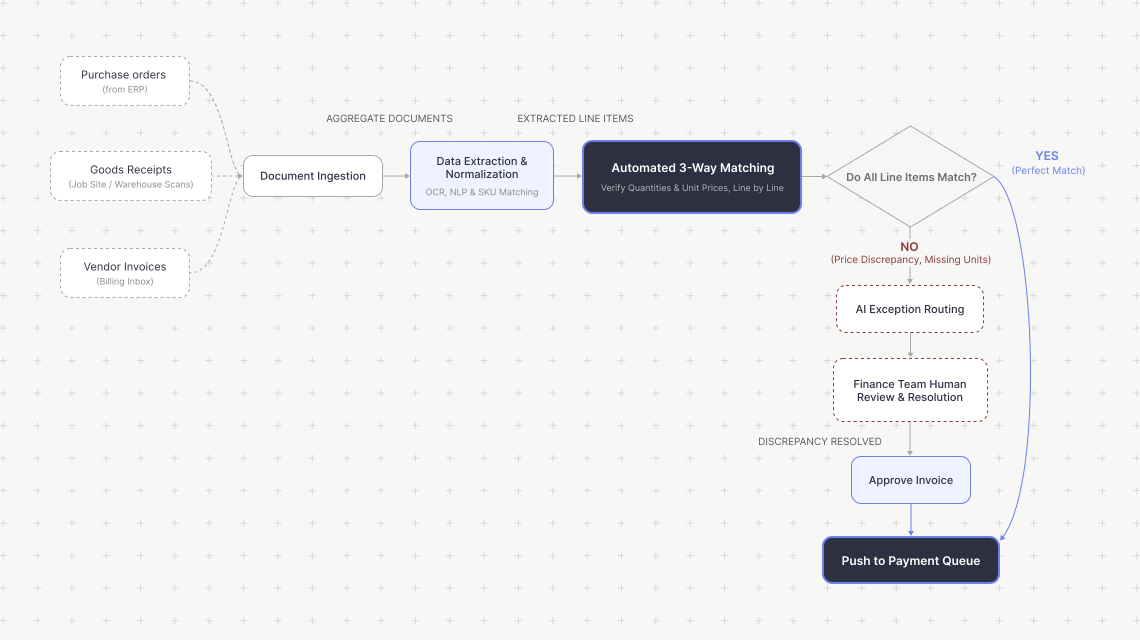
Ingestion.
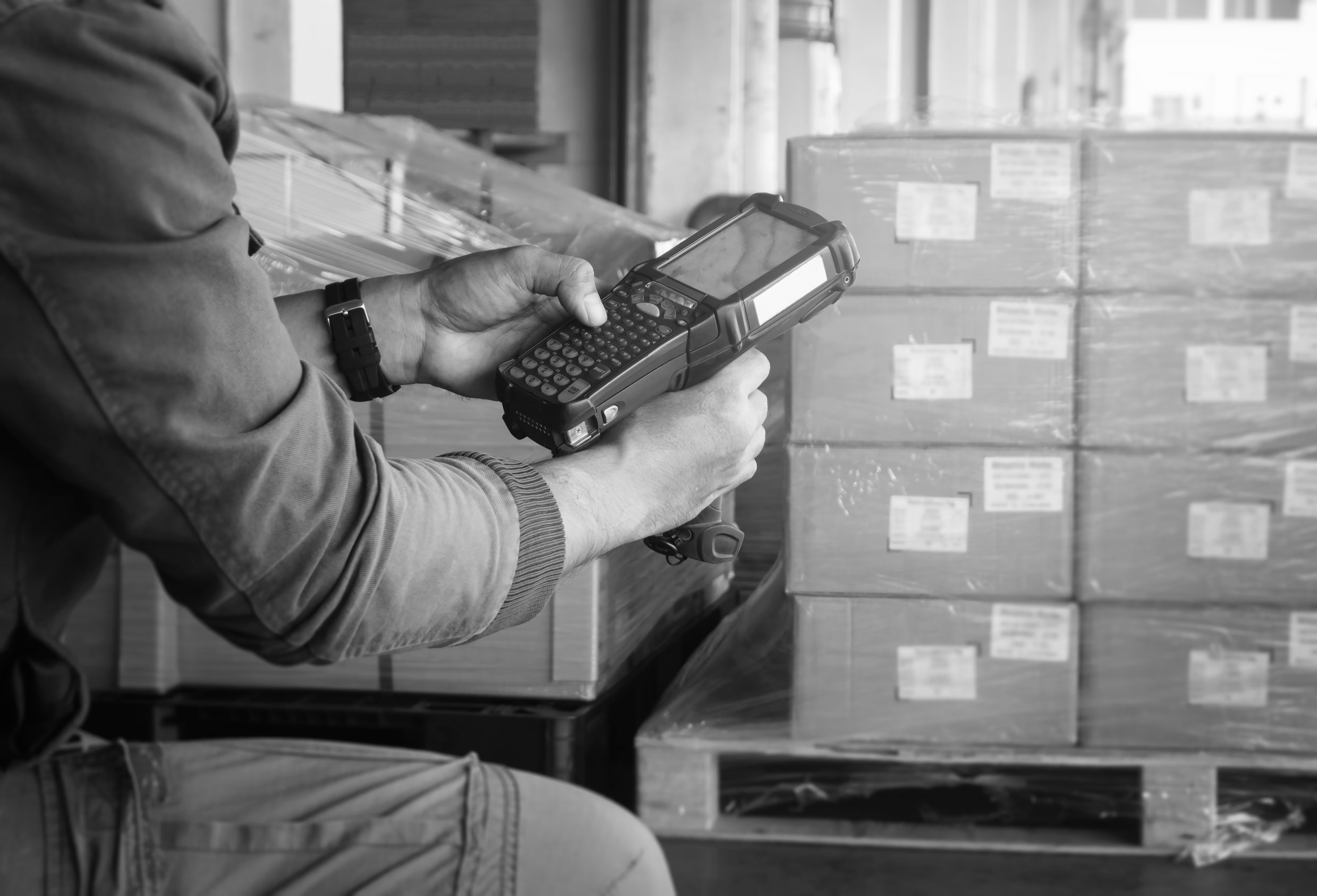
The system stops depending on site managers or AP staff to physically forward paperwork — the point where documents had previously gone missing or sat for days before anyone noticed. Purchase orders are pulled directly from the ERP. Delivery receipts, often handwritten or photographed at the job site or warehouse, and vendor invoices arriving by email are captured automatically as they come in, so the matching process can start the moment all three documents exist rather than whenever someone gets around to compiling them.
Extraction.
OCR and NLP extract the line-item data from each document — quantities, unit prices, descriptions — and translate vendor-specific part numbers and terminology into the company's internal SKU codes. This step matters more than it looks: one supplier might list "GI pipe" where another calls the same product "galvanized steel pipe," and a system that can't reconcile the language never gets to reconcile the numbers. Without that normalization step, three differently formatted, differently worded documents can't be compared at all — with it, they become directly comparable records.
Matching.
The system cross-references all three documents at the line-item level, not at the invoice level — quantity ordered against quantity received against quantity billed, and unit price billed against the contracted price, checked separately for every line rather than as a single lump-sum comparison. This is the step that used to require someone reading three documents side by side and manually reconciling each item; it now runs without anyone involved, as long as everything lines up.
Exception routing.
When the three documents agree, the invoice moves straight to the payment queue with no manual touch. When they don't — a price increase outside contract terms, a quantity shortfall, an unexplained freight charge — the system stops and routes the specific line item to the finance team, with the discrepancy already identified and the relevant documents attached, rather than left for someone to hunt down across three separate files.
Project Result
Reconciliations that used to take days of back-and-forth between AP, the warehouse, and the supplier now complete without anyone touching them, unless something is actually wrong. Suppliers get paid on schedule, and the credit-line conversations that used to reach the CFO's desk stopped happening.
Because discrepancies are caught the moment a document is ingested rather than weeks into the payment cycle, the company can raise a dispute with a supplier while it's still a fresh, easy conversation — not after the invoice has aged and the relationship has already absorbed the friction.
And the finance team is no longer spending its bandwidth reading three documents to find the one line that doesn't match. That time now goes toward cash flow analysis, vendor negotiation, and identifying which suppliers routinely price outside contract terms — work that actually requires a person's judgment, rather than their patience.
The Takeaway
The three-way match was never difficult as arithmetic. It was difficult because every invoice, clean or not, had to pass through the same manual review before anyone knew which one it was. Once the match runs automatically and only escalates genuine exceptions, reconciliation stops being a source of monthly gridlock and becomes something closer to a background check — invisible until it finds something worth a person's attention.
Self-check:
If your AP team is still comparing purchase orders, receipts, and invoices by hand, the question isn't whether the arithmetic is too hard for them — it's whether your process has any way of telling a clean match from a real exception before a person has to read all three documents to find out.


.png)


