
AI systems that hold up outside the demo
Kynera builds and integrates AI systems into the operations that already run - from feasibility assessment through production, with measurable economic return.
+ Scale & Margin
+ WORKFLOW AUTOMATION


Why most AI projects stall before production
.svg)
Kynera starts from the task. Feasibility is established first — data availability, expected accuracy, and cost per outcome — then the implementation approach is selected and built on a unified data layer capable of supporting it in production.
AI Implementation Services
AI Solution Development

Design and engineering of AI systems built for a specific operational purpose - from data preparation through model selection to production deployment.
AI Integration into Existing Systems
Connecting AI capabilities to the ERP, CRM, and operational platforms already running. Existing interfaces, permissions, and approval structures remain in place.
AI Readiness & Data Preparation
Establishing the data foundation AI depends on: structure, quality, access, and governance. Accuracy is determined here more than by model selection.
AI Cost & Performance Optimization
Reducing inference and infrastructure cost on systems already running - right-sizing model selection per task, restructuring retrieval and prompt chains, and eliminating token waste without degrading output.
AI Automation & Agent Deployment
Deploying AI into operational workflows where it executes work - routing, classification, drafting, and decision support running inside defined boundaries.
AI System Monitoring & Support
Ongoing tracking of accuracy, failure rates, and cost in operation, with adjustments as volume, data, and model pricing change.
AI Implementation Services
AI Solution Development
Design and engineering of AI systems built for a specific operational purpose - from data preparation through model selection to production deployment.
discussAI Integration into Existing Systems
Connecting AI capabilities to the ERP, CRM, and operational platforms already running. Existing interfaces, permissions, and approval structures remain in place.
discussAI Readiness & Data Preparation
Establishing the data foundation AI depends on: structure, quality, access, and governance. Accuracy is determined here more than by model selection.
discussAI Cost & Performance Optimization
Reducing inference and infrastructure cost on systems already running - right-sizing model selection per task, restructuring retrieval and prompt chains, and eliminating token waste without degrading output.
discussAI Automation & Agent Deployment
Deploying AI into operational workflows where it executes work - routing, classification, drafting, and decision support running inside defined boundaries.
discussAI System Monitoring & Support
Ongoing tracking of accuracy, failure rates, and cost in operation, with adjustments as volume, data, and model pricing change.
discussHow an AI Implementation Works
AI Feasibility Assessment
Identifying where AI creates measurable leverage in a specific operation - and where conventional automation is the better instrument. Output: a prioritized use-case map with return estimates.
Data & Infrastructure Readiness
Establishing whether the data environment supports the proposed solution, and defining what must be prepared before build begins. Where the underlying data requires structural work first, this is handled as data layer engineering.
Solution Design & Architecture
Designing the system: tool selection, integration points, data flows, and operating boundaries. Open-source, partner platform, or custom build depending on fit and cost.
Development & Integration
Engineering the solution into existing systems, with testing, validation, and performance benchmarks established before deployment.
Deployment, Monitoring & Optimization
Live deployment with accuracy monitoring, drift detection, and inference cost control. Model and retrieval decisions are revised as volume and pricing change.
Six AI applications with the clearest return
The implementations that produce measurable results in mid-market operations, selected by return. Each can be delivered as a standalone engagement or as part of a broader program.
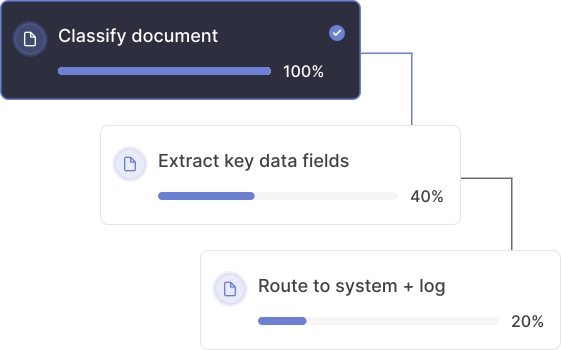
Intelligent Document Processing
Automated extraction, classification, and verification of structured data from invoices, contracts, and forms — across finance, logistics, procurement, and administration.

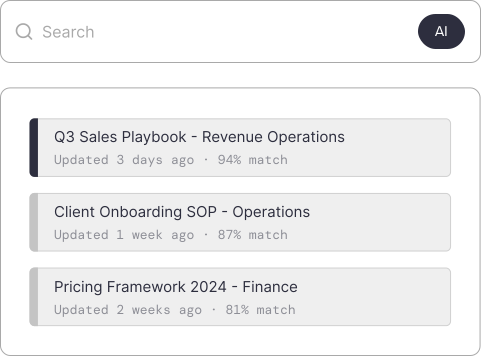
Internal Knowledge & Search AI
An assistant grounded in company documentation, policies, and operational records. Reduces information bottlenecks and shortens onboarding across departments.
Customer Service AI
An AI layer across client interactions — lead qualification, first-line support, FAQ resolution, and service routing, integrated into CRM and communication channels.

Predictive Analytics & Demand Forecasting
Purpose-built predictive models for specific operational decisions: demand planning, churn risk, delivery exceptions, and revenue modeling. Built for the decision, not as a generic platform.

AI Agents & Process Automation
Agents that execute. Integrated into operational systems, they run multi-step processes, trigger workflows, and coordinate across platforms within defined boundaries.
Computer Vision
Visual inspection for production, quality, and inventory — object detection, anomaly flagging, counting, and compliance monitoring from camera feeds or uploaded images.


We start every engagement with a feasibility assessment - identifying where AI creates measurable ROI and where it doesn't justify the investment.
Both. We select the right approach for each task - open-source, partner platforms, or custom-built - based on your requirements and budget.
For most applications, yes. Data readiness is assessed at the start of every engagement.
No. The applications we build augment your team's capacity - handling volume, repetition, and pattern recognition so people focus on higher-value work.
Yes. Integration into existing CRM, ERP, WMS, and operational tools is standard practice.
A focused pilot typically runs 3-6 weeks. Full production deployment: 2-4 months depending on complexity.
Every deployment includes performance benchmarks and monitoring. We optimize continuously - and flag underperformance before it impacts operations.
No. Mid-market is our primary market. Most applications we deploy don't require enterprise infrastructure or budgets.
Let's establish whether Kynera is the right fit for your organization
