
Decision Intelligence
Knowing what changed, why it matters, and what to do next
We build decision intelligence systems around the decisions business actually makes - connecting existing systems into one layer that monitors operations, models what is coming, and surfaces what needs attention with the context to act on it
+ FORECASTING & RISK
+ OPERATIONAL MONITORING
+ DECISION SUPPORT
+ OPERATIONAL MONITORING
+ DECISION SUPPORT

Problems it solves
Decision Intelligence is a discipline
Every organization runs on recurring decisions: what to reorder, which margin is slipping, where a delay is forming, which exposure is building, which client is about to leave. Most are made from partial information and nobody records what was decided or how it turned out.
What you can expect:
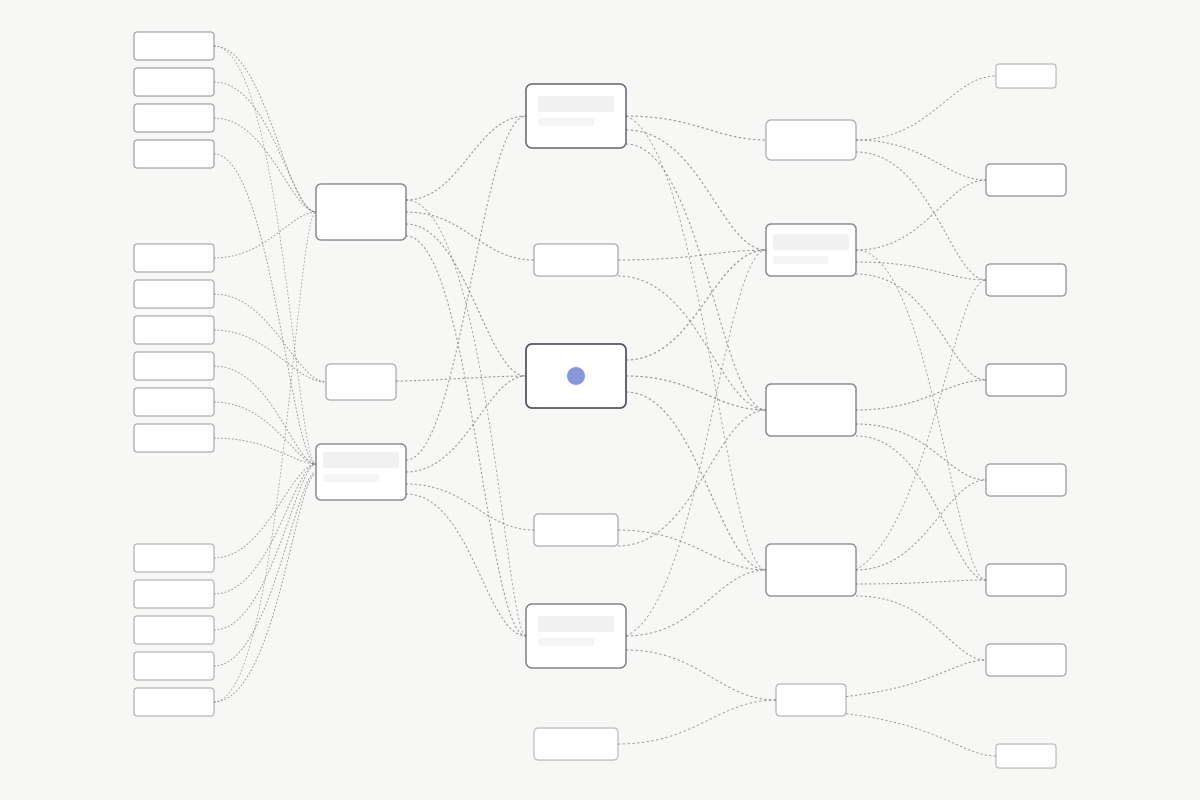
Decision intelligence connects existing systems into a layer that observes those decisions continuously. Surfacing what changed, modelling what follows, and delivering it where the work happens. What that layer does depends on which decisions carry weight: bottleneck and risk detection, demand forecasting, margin monitoring or exposure tracking.
What we do
Decision Intelligence Services
Operational Monitoring & Early Warning

improve and automate operations
Continuous monitoring across connected systems, with thresholds tuned to what genuinely requires action. Deviations surface while they are still correctable.
→ discuss
Pricing & Margin Intelligence
Landed cost tracked against list price, margin floors enforced at quote level, and discount patterns surfaced by account, product, and owner. Prices follow cost movement instead of drifting behind it.
→ discuss
Forecasting & Predictive Models
build reliable data foundation
Demand, capacity, cash flow, and utilisation modelled on operational history. Planning moves from extrapolation to projection with confidence intervals.
→ discuss
Risk & Anomaly Detection
Automated detection of irregularities in transactions, inventory, exposure, and process performance — including patterns that disappear in aggregate reporting.
→ discuss
Scenario Modelling & Simulation
enable real-time data-driven decision making
Modelling the effect of a decision before it is taken - capacity changes, pricing moves, supplier shifts, and demand scenarios tested against current data.
→ discuss
Decision Intelligence Platform Implementation
build custom systems and tools
Deployment and configuration of established DI platforms where a commercial product fits the requirement better than a custom build.
→ discuss
What we do
Decision Intelligence Services
Operational Monitoring & Early Warning
Continuous monitoring across connected systems, with thresholds tuned to what genuinely requires action. Deviations surface while they are still correctable.
discussPricing & Margin Intelligence
Landed cost tracked against list price, margin floors enforced at quote level, and discount patterns surfaced by account, product, and owner. Prices follow cost movement instead of drifting behind it.
discussForecasting & Predictive Models
Demand, capacity, cash flow, and utilisation modelled on operational history. Planning moves from extrapolation to projection with confidence intervals.
discussRisk & Anomaly Detection
Automated detection of irregularities in transactions, inventory, exposure, and process performance — including patterns that disappear in aggregate reporting.
discussScenario Modelling & Simulation
Modelling the effect of a decision before it is taken - capacity changes, pricing moves, supplier shifts, and demand scenarios tested against current data.
discussDecision Intelligence Platform Implementation
Deployment and configuration of established DI platforms where a commercial product fits the requirement better than a custom build.
discussHow it works
A single operational layer that connects data, decisions, and execution
Decision intelligence connects CRM, ERP, WMS, BI, and operational tools into one governed decision flow. Nothing is replaced.

Data & Signal Layer
Existing sources unify into real-time operational signals. The Decision Intelligence system surfaces what matters before it becomes a spreading problem.

Decision Intelligence Layer
Recurring decisions become structured, visible, and evidence-based. Each carries an owner, a timeline, and an expected outcome, traceable from signal to execution.

Operational Logic & Traceability
Decision flows map to actual processes, governance model, and organizational structure, so the system reflects how the organization runs.
Decision intelligence attaches to whichever decisions carry cost, risk, or timing pressure. The domain varies by organization.
2026
Gartner formalised Decision Intelligence as a category
5-20%
current adoption across organizationshe market
Domain
Typical application
Stock exposure, supplier delay signals, reorder timing
Margin & pricing
Cost drift, discount leakage, quote-level margin control
Financial exposure
Receivables risk, cash position modelling, covenant tracking
Operational throughput
Bottleneck detection, capacity constraints, cycle deviation
Client & revenue
Churn signals, account health, pipeline reliability
Compliance & control
Policy deviation, audit trail, decision consistency across regulated processes


HOW WE WORK
How a decision intelligence project runs
One decision domain is scoped, built, and proven in the environment before anything extends further.
Decision Mapping
STAGE 01
Establishing which recurring decisions carry cost, risk, or timing pressure — who makes them, on what information, and what happens when they are wrong. One domain is selected on return and data readiness.
2 weeks
TYPICAL DURATION
Signal Design & Data Connection
STAGE 02
Defining what the system must observe and at what threshold action is warranted, then connecting the source systems that carry those signals. Detection logic is specified before anything is built.
2–3 weeks
TYPICAL DURATION
Build & Calibration
STAGE 03
Building the monitoring, modelling, and recommendation logic, then calibrating thresholds against historical data so the system flags what matters and stays quiet otherwise.
4–8 weeks
TYPICAL DURATION
Live Validation
STAGE 04
Running against real operations while decisions continue as before. Every signal is reviewed for accuracy until the output is trusted by the people who will act on it.
3–4 weeks
TYPICAL DURATION
Handover & Extension
STAGE 05
Documentation, ownership transfer, and the sequence for adding the next decision domain onto the same foundation
1–2 weeks
TYPICAL DURATION
Problems Surface Early
Deviations and execution gaps appear the moment they form, with alerts reaching the owner before impact spreads.
Decisions Carry Evidence
Each recurring decision connects to the data behind it, the person accountable, and the outcome that followed.
Forecasts Replace Estimates
Planning runs on modelled projection rather than on last year adjusted by feel.
Margin Holds Under Pressure
Cost movement reaches pricing before it reaches the P&L, and discounting stays inside policy.
Leadership Acts on Current Data
Decisions are made in hours from one trusted source instead of after a reporting cycle closes.
The System Extends
New decision domains, departments, and data sources are added without rebuilding the foundation.
outcomes
Operational impact of decision intelligence
faq
In case you have some questions, we might already have an answer.
What is decision intelligence exactly?
A discipline for engineering how recurring decisions get made — connecting data, models, and business rules so that decisions carry evidence, an owner, and a measurable outcome. Gartner formalised it as a category with its first Magic Quadrant in January 2026.
Is this just another dashboard tool?
No. Business intelligence reports what happened. Decision intelligence produces recommended actions delivered where the work happens, and records what followed.
Do you replace our existing systems?
No. The layer sits above CRM, ERP, WMS, BI, and operational tools, connecting them instead of substituting for them.
Are we big enough for this?
It requires recurring decisions worth systematising — typically several departments, meaningful data volume, and decisions currently made from partial information. Below that threshold, better reporting solves the problem at a fraction of the cost.
Can we start with one area?
That is the recommended approach. A single decision domain is scoped, built, and proven before anything extends further.
How long does implementation take?
A scoped single-domain build typically runs 8–14 weeks to production. Full multi-domain deployment extends from there.
Who in the organization uses this?
Operational owners receive signals and recommendations; leadership receives visibility and forecast. The system reaches whoever owns the decision.
Do we need clean data before starting?
The data supporting the chosen decision domain must be reliable. That scope is assessed at mapping, and remediation is handled before the system depends on it.
What does it cost to run?
Custom systems carry infrastructure and maintenance cost without per-seat licensing. Platform implementations carry subscription cost scaling with users and volume. Both are modelled before commitment.
Contact Us
Let's establish whether Kynera is the right fit for your organization
Email
hello@thekynera.com
Support
info@thekynera.com
Customer Service
Mon-Fri 10am-6pm
+1 (437) 476-6900
LinkedIn
@thekynera
Oops! Something went wrong while submitting the form.
